
# 501. Mode in Binary Search Tree
LeetCode problem link (opens new window)
Given a binary search tree (BST) with duplicates, find all the modes (elements with the highest frequency) in the BST.
Assume the BST is defined as follows:
- The value of nodes in the left subtree is less than or equal to the value of the current node
- The value of nodes in the right subtree is greater than or equal to the value of the current node
- Both the left and right subtrees are binary search trees
Example:
Given BST [1,null,2,2],
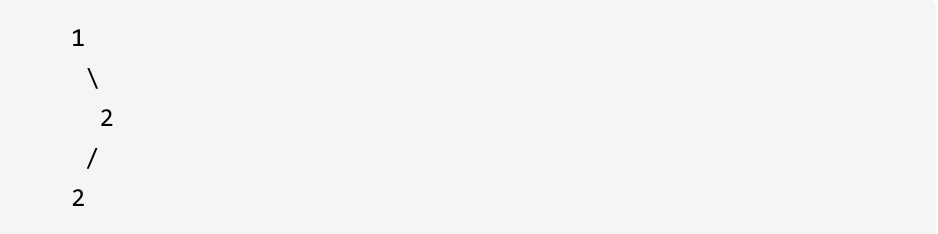
Return [2].
Note: If the mode is more than one, output order does not matter.
Follow up: Could you do that without using any extra space? (Assuming the implicit stack space generated by the recursion does not count).
# Approach
This problem has a recursive approach that I will explain from two perspectives.
First, let's consider how to solve it if it's not a binary search tree. Then, we'll see how the BST property can be leveraged to solve the problem differently. Comparing the two methods can deepen your understanding of binary trees.
# Recursive Approach
# If it's not a binary search tree
For a general binary tree, the most straightforward method is to traverse the tree, use a map to count frequencies, sort the frequencies, and then choose the elements with the highest frequencies.
Specific steps are as follows:
- Traverse the entire tree and use a map to count frequency
The traversal order doesn't matter since you need to cover the entire tree. Preorder, inorder, postorder, and even level-order traversal will work. Here we use preorder traversal with the following code:
// Map<int, int> key: element, value: frequency
void searchBST(TreeNode* cur, unordered_map<int, int>& map) { // Preorder traversal
    if (cur == NULL) return;
    map[cur->val]++; // Count element frequency
    searchBST(cur->left, map);
    searchBST(cur->right, map);
    return;
}
2
3
4
5
6
7
8
- Sort the frequencies stored in the map
You cannot sort values directly in a map using C++ standard library features if you’re using std::map or std::multimap. Thus, convert the map to a vector, which also stores pair<int, int> where the first int is the element and the second int is the frequency.
bool static cmp (const pair<int, int>& a, const pair<int, int>& b) {
    return a.second > b.second; // Sort frequencies in descending order
}

vector<pair<int, int>> vec(map.begin(), map.end());
sort(vec.begin(), vec.end(), cmp); // Sort by frequency
2
3
4
5
6
- Pick the elements with the highest frequency
The vector contains pairs sorted by frequency; now you can choose elements with the highest frequency:
result.push_back(vec[0].first);
for (int i = 1; i < vec.size(); i++) {
    if (vec[i].second == vec[0].second) result.push_back(vec[i].first);
    else break;
}
return result;
2
3
4
5
6
The whole C++ code is as follows:
class Solution {
private:

void searchBST(TreeNode* cur, unordered_map<int, int>& map) {
    if (cur == NULL) return;
    map[cur->val]++;
    searchBST(cur->left, map);
    searchBST(cur->right, map);
    return;
}
bool static cmp (const pair<int, int>& a, const pair<int, int>& b) {
    return a.second > b.second;
}
public:
    vector<int> findMode(TreeNode* root) {
        unordered_map<int, int> map;
        vector<int> result;
        if (root == NULL) return result;
        searchBST(root, map);
        vector<pair<int, int>> vec(map.begin(), map.end());
        sort(vec.begin(), vec.end(), cmp);
        result.push_back(vec[0].first);
        for (int i = 1; i < vec.size(); i++) {
            if (vec[i].second == vec[0].second) result.push_back(vec[i].first);
            else break;
        }
        return result;
    }
};
2
3
4
5
6
7
8
9
10
11
12
13
14
15
16
17
18
19
20
21
22
23
24
25
26
27
28
29
If the problem didn’t specify that the tree is a binary search tree, you would solve it using the above logic!
# If it is a binary search tree
Since it's a binary search tree, its inorder traversal is sorted.
For example:
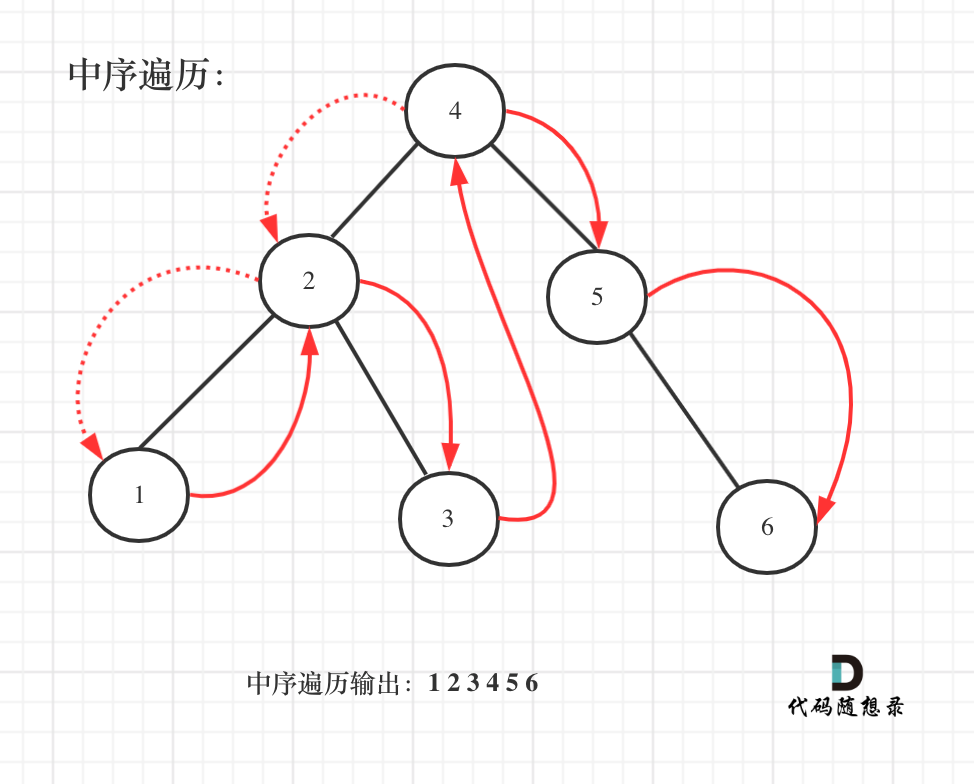
Inorder traversal code is as follows:
void searchBST(TreeNode* cur) {
    if (cur == NULL) return;
    searchBST(cur->left);
    (process the node)
    searchBST(cur->right);
    return;
}
2
3
4
5
6
7
When traversing a sorted array for mode, you compare consecutive elements and keep a collection of the most frequent elements.
The problem is, in a binary tree, how can this be managed efficiently?
One approach is to have a pointer pointing to the previous node, allowing the current node (cur) to be compared with the pre (previous node).
Initially, set pre = NULL to recognize the first element.
if (pre == NULL) { // First node
    count = 1; // Frequency is 1
} else if (pre->val == cur->val) { // Same as previous node
    count++;
} else { // Different from the previous node
    count = 1;
}
pre = cur; // Update the previous node
2
3
4
5
6
7
8
If count equals maxCount, you should add this element to the result vector. If count is greater than maxCount, update maxCount and clear the result vector.
if (count == maxCount) {
    result.push_back(cur->val);
}

if (count > maxCount) {
    maxCount = count;
    result.clear();
    result.push_back(cur->val);
}
2
3
4
5
6
7
8
9
The complete code is below: (You can get all modes with a single tree traversal.)
class Solution {
private:
    int maxCount = 0;
    int count = 0;
    TreeNode* pre = NULL;
    vector<int> result;
    void searchBST(TreeNode* cur) {
        if (cur == NULL) return;

        searchBST(cur->left);

        if (pre == NULL) {
            count = 1;
        } else if (pre->val == cur->val) {
            count++;
        } else {
            count = 1;
        }
        pre = cur;

        if (count == maxCount) {
            result.push_back(cur->val);
        }

        if (count > maxCount) {
            maxCount = count;
            result.clear();
            result.push_back(cur->val);
        }

        searchBST(cur->right);
        return;
    }

public:
    vector<int> findMode(TreeNode* root) {
        count = 0;
        maxCount = 0;
        pre = NULL;
        result.clear();

        searchBST(root);
        return result;
    }
};
2
3
4
5
6
7
8
9
10
11
12
13
14
15
16
17
18
19
20
21
22
23
24
25
26
27
28
29
30
31
32
33
34
35
36
37
38
39
40
41
42
43
44
45
# Iterative Approach
The code logic is the same; we just use an iterative inorder traversal:
Refer to:
- Binary Tree Iterative Traversal (opens new window)
- Unified Iterative Traversal of Binary Tree (opens new window)
The following is one way to do an inorder traversal iteratively, maintaining the logic:
class Solution {
public:
    vector<int> findMode(TreeNode* root) {
        stack<TreeNode*> st;
        TreeNode* cur = root;
        TreeNode* pre = NULL;
        int maxCount = 0;
        int count = 0;
        vector<int> result;
        while (cur != NULL || !st.empty()) {
            if (cur != NULL) {
                st.push(cur);
                cur = cur->left;
            } else {
                cur = st.top();
                st.pop();
                if (pre == NULL) {
                    count = 1;
                } else if (pre->val == cur->val) {
                    count++;
                } else {
                    count = 1;
                }
                if (count == maxCount) {
                    result.push_back(cur->val);
                }

                if (count > maxCount) {
                    maxCount = count;
                    result.clear();
                    result.push_back(cur->val);
                }
                pre = cur;
                cur = cur->right;
            }
        }
        return result;
    }
};
2
3
4
5
6
7
8
9
10
11
12
13
14
15
16
17
18
19
20
21
22
23
24
25
26
27
28
29
30
31
32
33
34
35
36
37
38
39
# Conclusion
In the recursive approach, I've shown how to solve for modes in a general binary tree context. Then I introduced how to leverage the binary search tree property to find modes efficiently, enhancing binary tree understanding.
When traversing the binary search tree, I introduced a technique to find the most frequent elements in one pass, instead of traversing the tree twice. If the task was simpler and required a single mode, one pass would suffice.
Finally, I provided a corresponding iterative approach by adding the central node processing logic.
Identifying the mode in a binary search tree is a simple problem, but understanding the approach deeply can be quite enlightening when learning binary trees.