
# 1020. Number of Enclaves
LeetCode Link (opens new window)
You are given an m x n binary matrix grid, where 0 represents an ocean cell and 1 represents a land cell.
A move is defined as walking from one land cell to an adjacent (up, down, left, or right) land cell or crossing the boundary of the grid.
Return the number of land cells in the grid that cannot reach the grid boundary in any number of moves.
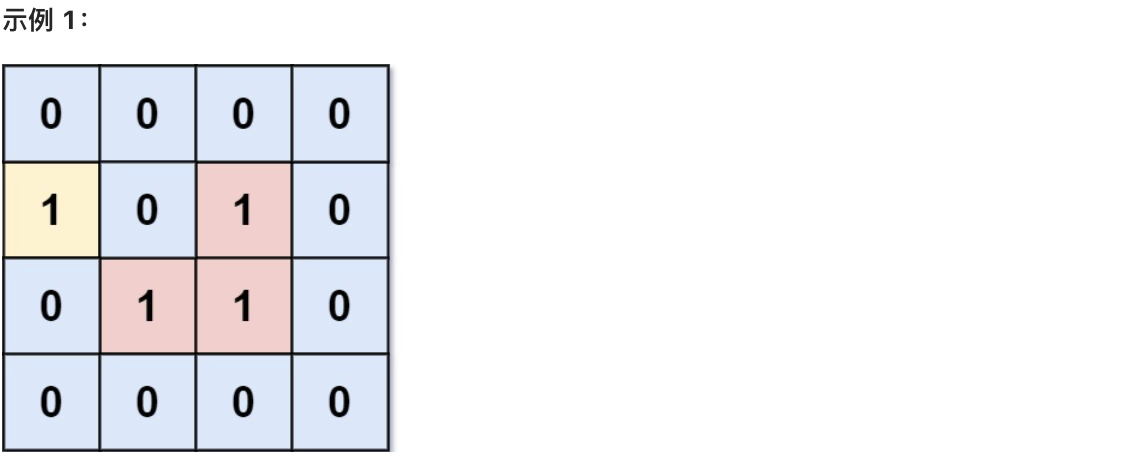
- Input:
grid = [[0,0,0,0],[1,0,1,0],[0,1,1,0],[0,0,0,0]] - Output:
3 - Explanation: There are three
1s that are surrounded by0s. One1is not surrounded because it is on the boundary.
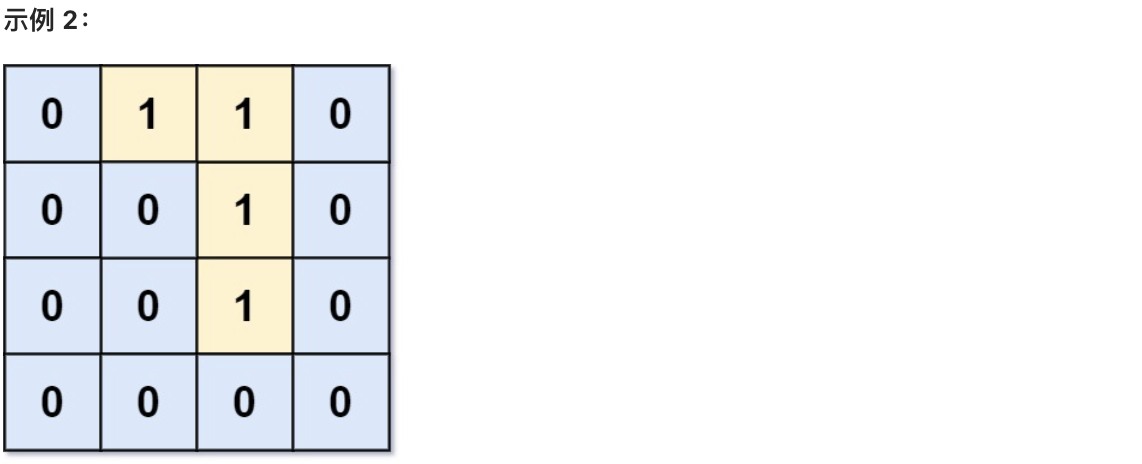
- Input:
grid = [[0,1,1,0],[0,0,1,0],[0,0,1,0],[0,0,0,0]] - Output:
0 - Explanation: All
1s are on the boundary or can reach the boundary.
# Approach
This problem can be solved using DFS, BFS, or a Union-Find (Disjoint Set Union, DSU) approach.
The task is to find the land area that is not adjacent to the boundary. We can start from the land on the boundary and change adjacent land cells connected by DFS or BFS to ocean. Then, when we traverse the map again, we can count the number of lands left.
As shown in the illustration, by traversing the four sides of the map, the land adjacent to the perimeter of the map turns green.
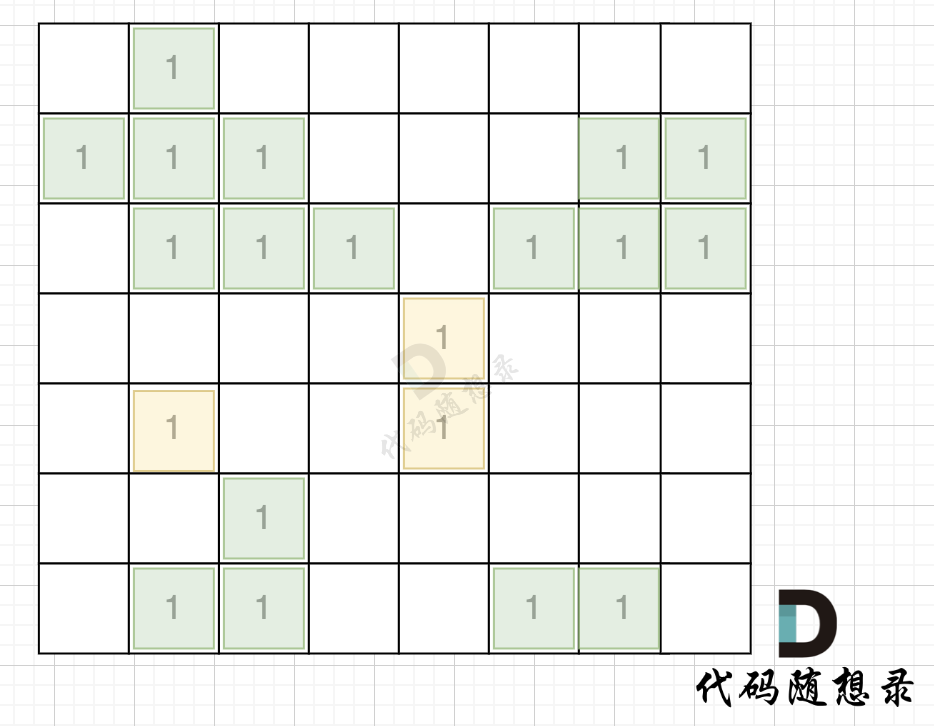
When land on the map perimeter is found, turn 1s into 0s, resulting in a map like this:
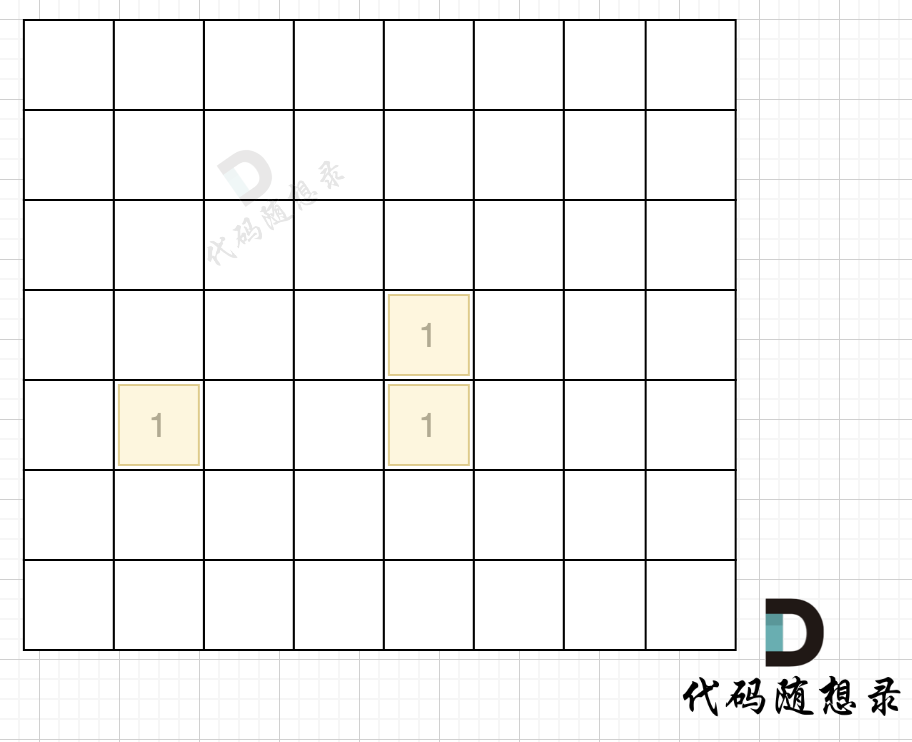
Then, traverse the map again, applying depth-first or breadth-first search on land cells to count them.
If you are unfamiliar with depth-first search or breadth-first search, it is recommended to check here: In-depth Explanation of Depth-First Search (opens new window), In-depth Explanation of Breadth-First Search (opens new window).
Below is the code using depth-first search:
class Solution {
private:
    int dir[4][2] = {-1, 0, 0, -1, 1, 0, 0, 1}; // Four directions
    int count; // Count of land cells that meet the requirement
    void dfs(vector<vector<int>>& grid, int x, int y) {
        grid[x][y] = 0;
        count++;
        for (int i = 0; i < 4; i++) { // Traverse in four directions
            int nextx = x + dir[i][0];
            int nexty = y + dir[i][1];
            // Out of boundary
            if (nextx < 0 || nextx >= grid.size() || nexty < 0 || nexty >= grid[0].size()) continue;
            // Condition does not meet, stop traversing
            if (grid[nextx][nexty] == 0) continue;

            dfs(grid, nextx, nexty);
        }
        return;
    }

public:
    int numEnclaves(vector<vector<int>>& grid) {
        int n = grid.size(), m = grid[0].size();
        // Traverse from the left and right bounds toward the center
        for (int i = 0; i < n; i++) {
            if (grid[i][0] == 1) dfs(grid, i, 0);
            if (grid[i][m - 1] == 1) dfs(grid, i, m - 1);
        }
        // Traverse from the top and bottom bounds toward the center
        for (int j = 0; j < m; j++) {
            if (grid[0][j] == 1) dfs(grid, 0, j);
            if (grid[n - 1][j] == 1) dfs(grid, n - 1, j);
        }
        count = 0;
        for (int i = 0; i < n; i++) {
            for (int j = 0; j < m; j++) {
                if (grid[i][j] == 1) dfs(grid, i, j);
            }
        }
        return count;
    }
};
2
3
4
5
6
7
8
9
10
11
12
13
14
15
16
17
18
19
20
21
22
23
24
25
26
27
28
29
30
31
32
33
34
35
36
37
38
39
40
41
42
Here is the code using breadth-first search:
class Solution {
private:
    int count = 0;
    int dir[4][2] = {0, 1, 1, 0, -1, 0, 0, -1}; // Four directions
    void bfs(vector<vector<int>>& grid, int x, int y) {
        queue<pair<int, int>> que;
        que.push({x, y});
        grid[x][y] = 0; // Immediately mark when added to queue
        count++;
        while (!que.empty()) {
            pair<int, int> cur = que.front(); que.pop();
            int curx = cur.first;
            int cury = cur.second;
            for (int i = 0; i < 4; i++) {
                int nextx = curx + dir[i][0];
                int nexty = cury + dir[i][1];
                if (nextx < 0 || nextx >= grid.size() || nexty < 0 || nexty >= grid[0].size()) continue;  // Out of boundary, skip
                if (grid[nextx][nexty] == 1) {
                    que.push({nextx, nexty});
                    count++;
                    grid[nextx][nexty] = 0; // Immediately mark when added to queue
                }
            }
        }
    }

public:
    int numEnclaves(vector<vector<int>>& grid) {
        int n = grid.size(), m = grid[0].size();
        // From the left and right edges, traverse toward the center
        for (int i = 0; i < n; i++) {
            if (grid[i][0] == 1) bfs(grid, i, 0);
            if (grid[i][m - 1] == 1) bfs(grid, i, m - 1);
        }
        // From the top and bottom edges, traverse toward the center
        for (int j = 0; j < m; j++) {
            if (grid[0][j] == 1) bfs(grid, 0, j);
            if (grid[n - 1][j] == 1) bfs(grid, n - 1, j);
        }
        count = 0;
        for (int i = 0; i < n; i++) {
            for (int j = 0; j < m; j++) {
                if (grid[i][j] == 1) bfs(grid, i, j);
            }
        }
        return count;
    }
};
2
3
4
5
6
7
8
9
10
11
12
13
14
15
16
17
18
19
20
21
22
23
24
25
26
27
28
29
30
31
32
33
34
35
36
37
38
39
40
41
42
43
44
45
46
47
48
# Other Language Versions
# Java
Depth-First Search (DFS) without a termination condition and space optimization (flood the island, no visited array used)
// DFS
class Solution {
    int count = 0;
    int[][] dir ={
        {0, 1},
        {1, 0},
        {-1, 0},
        {0, -1}
    };
    private void dfs(int[][] grid, int x, int y){
        if(grid[x][y] == 0)
            return;

        grid[x][y] = 0;
        count++;

        for(int i = 0; i < 4; i++){
            int nextX = x + dir[i][0];
            int nextY = y + dir[i][1];

            if(nextX < 0 || nextY < 0 || nextX >= grid.length || nextY >= grid[0].length)
                continue;
            dfs(grid, nextX, nextY);
        }

    }

    public int numEnclaves(int[][] grid) {
        for(int i = 0; i < grid.length; i++){
            if(grid[i][0] == 1)
                dfs(grid, i, 0);
            if(grid[i][grid[0].length - 1] == 1)
                dfs(grid, i, grid[0].length - 1);
        }
        // Adjusted j's bounds to avoid unnecessary repeated operations.
        for(int j = 1; j < grid[0].length - 1; j++){
            if(grid[0][j] == 1)
                dfs(grid, 0, j);
            if(grid[grid.length - 1][j] == 1)
                dfs(grid, grid.length - 1, j);
        }
        count = 0;

        for(int i = 1; i < grid.length - 1; i++){
            for(int j = 1; j < grid[0].length - 1; j++){
                if(grid[i][j] == 1)
                    dfs(grid, i, j);
            }
        }
        return count;
    }
}
2
3
4
5
6
7
8
9
10
11
12
13
14
15
16
17
18
19
20
21
22
23
24
25
26
27
28
29
30
31
32
33
34
35
36
37
38
39
40
41
42
43
44
45
46
47
48
49
50
51
52
Depth-First Search (DFS) without termination condition
class Solution {
    // Four directions
    private static final int[][] position = {{-1, 0}, {0, 1}, {1, 0}, {0, -1}};

    // Depth-First Search, marking all 1s that can reach the boundary as true
    public void dfs(int[][] grid, int row, int col, boolean[][] visited) {
        for (int[] current: position) {
            int newRow = row + current[0], newCol = col + current[1];
            // Index out of bounds, skip
            if (newRow < 0 || newRow >= grid.length || newCol < 0 || newCol >= grid[0].length) continue;
            // Current position is not 1 or already visited
            if (grid[newRow][newCol] != 1 || visited[newRow][newCol]) continue;
            visited[newRow][newCol] = true;
            dfs(grid, newRow, newCol, visited);
        }
    }

    public int numEnclaves(int[][] grid) {
        int rowSize = grid.length, colSize = grid[0].length, ans = 0;	// `ans` records the result
        // A boolean array marks each `1`'s position whether it can reach the boundary
        boolean[][] visited = new boolean[rowSize][colSize];
        // Traverse from the left and right edges toward the center
        for (int row = 0; row < rowSize; row++) {
            if (grid[row][0] == 1 && !visited[row][0]) {
                visited[row][0] = true;
                dfs(grid, row, 0, visited);
            }
            if (grid[row][colSize - 1] == 1 && !visited[row][colSize - 1]) {
                visited[row][colSize - 1] = true;
                dfs(grid, row, colSize - 1, visited);
            }
        }
        // Traverse the top and bottom edges toward the center but skip the corners as they have been handled
        for (int col = 1; col < colSize - 1; col++) {
            if (grid[0][col] == 1 && !visited[0][col]) {
                visited[0][col] = true;
                dfs(grid, 0, col, visited);
            }
            if (grid[rowSize - 1][col] == 1 && !visited[rowSize - 1][col]) {
                visited[rowSize - 1][col] = true;
                dfs(grid, rowSize - 1, col, visited);
            }
        }
        // Find unmarked `1`s and record into `ans`
        for (int row = 0; row < rowSize; row++) {
            for (int col = 0; col < colSize; col++) {
                if (grid[row][col] == 1 && !visited[row][col]) ++ans;
            }
        }
        return ans;
    }
}
2
3
4
5
6
7
8
9
10
11
12
13
14
15
16
17
18
19
20
21
22
23
24
25
26
27
28
29
30
31
32
33
34
35
36
37
38
39
40
41
42
43
44
45
46
47
48
49
50
51
52
Breadth-First Search (BFS) with a visited array
class Solution {
    // Four directions
    private static final int[][] position = {{-1, 0}, {0, 1}, {1, 0}, {0, -1}};

    // Breadth-First Search, marking all `1`s that can reach the boundary as true
    public void bfs(int[][] grid, Queue<int[]> queue, boolean[][] visited) {
        while (!queue.isEmpty()) {
            int[] curPos = queue.poll();
            for (int[] current: position) {
                int row = curPos[0] + current[0], col = curPos[1] + current[1];
                // Index out of bounds, skip
                if (row < 0 || row >= grid.length || col < 0 || col >= grid[0].length) continue;
                // Current position is not 1 or already visited
                if (visited[row][col] || grid[row][col] == 0) continue;
                visited[row][col] = true;
                queue.add(new int[]{row, col});
            }
        }
    }

    public int numEnclaves(int[][] grid) {
        int rowSize = grid.length, colSize = grid[0].length, ans = 0;	// `ans` records the result
        // A boolean array marks each `1`'s position whether it can reach the boundary
        boolean[][] visited = new boolean[rowSize][colSize];
        Queue<int[]> queue = new ArrayDeque<>();
        // Traverse from the left and right edges toward the center
        for (int row = 0; row < rowSize; row++) {
            if (grid[row][0] == 1) {
                visited[row][0] = true;
                queue.add(new int[]{row, 0});
            }
            if (grid[row][colSize - 1] == 1) {
                visited[row][colSize - 1] = true;
                queue.add(new int[]{row, colSize - 1});
            }
        }
        // Traverse the top and bottom edges but skip the corners as they have been handled
        for (int col = 1; col < colSize - 1; col++) {
            if (grid[0][col] == 1) {
                visited[0][col] = true;
                queue.add(new int[]{0, col});
            }
            if (grid[rowSize - 1][col] == 1) {
                visited[rowSize - 1][col] = true;
                queue.add(new int[]{rowSize - 1, col});
            }
        }
        bfs(grid, queue, visited);		// Breadth-First Search
        // Find unmarked `1`s and record into `ans`
        for (int row = 0; row < rowSize; row++) {
            for (int col = 0; col < colSize; col++) {
                if (grid[row][col] == 1 && !visited[row][col]) ++ans;
            }
        }
        return ans;
    }
}
2
3
4
5
6
7
8
9
10
11
12
13
14
15
16
17
18
19
20
21
22
23
24
25
26
27
28
29
30
31
32
33
34
35
36
37
38
39
40
41
42
43
44
45
46
47
48
49
50
51
52
53
54
55
56
57
Breadth-First Search (BFS) with space optimization (flood the island, no visited array used)
// BFS
class Solution {
    int count = 0;
    int[][] dir ={
        {0, 1},
        {1, 0},
        {-1, 0},
        {0, -1}
    };
    private void bfs(int[][] grid, int x, int y){
        Queue<Integer> que = new LinkedList<>();
        que.offer(x);
        que.offer(y);
        count++;
        grid[x][y] = 0;

        while(!que.isEmpty()){
            int currX = que.poll();
            int currY = que.poll();

            for(int i = 0; i < 4; i++){
                int nextX = currX + dir[i][0];
                int nextY = currY + dir[i][1];

                if(nextX < 0 || nextY < 0 || nextX >= grid.length || nextY >= grid[0].length)
                    continue;

                if(grid[nextX][nextY] == 1){
                    que.offer(nextX);
                    que.offer(nextY);
                    count++;
                    grid[nextX][nextY] = 0;
                }
            }
        }
    }

    public int numEnclaves(int[][] grid) {
        for(int i = 0; i < grid.length; i++){
            if(grid[i][0] == 1)
                bfs(grid, i, 0);
            if(grid[i][grid[0].length - 1] == 1)
                bfs(grid, i, grid[0].length - 1);
        }
        for(int j = 1; j < grid[0].length; j++){
            if(grid[0][j] == 1)
                bfs(grid, 0 , j);
            if(grid[grid.length - 1][j] == 1)
                bfs(grid, grid.length - 1, j);
        }
        count = 0;
        for(int i = 1; i < grid.length - 1; i++){
            for(int j = 1; j < grid[0].length - 1; j++){
                if(grid[i][j] == 1)
                    bfs(grid,i ,j);
            }
        }
        return count;
    }
}
2
3
4
5
6
7
8
9
10
11
12
13
14
15
16
17
18
19
20
21
22
23
24
25
26
27
28
29
30
31
32
33
34
35
36
37
38
39
40
41
42
43
44
45
46
47
48
49
50
51
52
53
54
55
56
57
58
59
60
# Python
Depth-First Search (DFS)
class Solution:
    def __init__(self):
        self.position = [[-1, 0], [0, 1], [1, 0], [0, -1]]	# Four directions

    # Depth-First Search to mark all 1s that can reach the border as true
    def dfs(self, grid: List[List[int]], row: int, col: int, visited: List[List[bool]]) -> None:
        for current in self.position:
            newRow, newCol = row + current[0], col + current[1]
            # Initial index check
            if newRow < 0 or newRow >= len(grid) or newCol < 0 or newCol >= len(grid[0]):
                continue
            # Current position isn't 1 or is already visited
            if grid[newRow][newCol] == 0 or visited[newRow][newCol]: continue
            visited[newRow][newCol] = True
            self.dfs(grid, newRow, newCol, visited)

    def numEnclaves(self, grid: List[List[int]]) -> int:
        rowSize, colSize, ans = len(grid), len(grid[0]), 0
        # Boolean array to track if a 1 position can reach the boundary or not
        visited = [[False for _ in range(colSize)] for _ in range(rowSize)]
        # Check the left and right boundaries for 1s
        for row in range(rowSize):
            if grid[row][0] == 1:
                visited[row][0] = True
                self.dfs(grid, row, 0, visited)
            if grid[row][colSize - 1] == 1:
                visited[row][colSize - 1] = True
                self.dfs(grid, row, colSize - 1, visited)
        # Check the top and bottom boundaries for 1s but avoid the corners
        for col in range(1, colSize - 1):
            if grid[0][col] == 1:
                visited[0][col] = True
                self.dfs(grid, 0, col, visited)
            if grid[rowSize - 1][col] == 1:
                visited[rowSize - 1][col] = True
                self.dfs(grid, rowSize - 1, col, visited)
        # Find unmarked 1s and record them to the answer
        for row in range(rowSize):
            for col in range(colSize):
                if grid[row][col] == 1 and not visited[row][col]:
                    ans += 1
        return ans
2
3
4
5
6
7
8
9
10
11
12
13
14
15
16
17
18
19
20
21
22
23
24
25
26
27
28
29
30
31
32
33
34
35
36
37
38
39
40
41
42
Breadth-First Search (BFS)
class Solution:
    def __init__(self):
        self.position = [[-1, 0], [0, 1], [1, 0], [0, -1]]	# Four directions

    # Breadth-First Search, marking all 1s that can reach the boundary as true
    def bfs(self, grid: List[List[int]], queue: deque, visited: List[List[bool]]) -> None:
        while queue:
            curPos = queue.popleft()
            for current in self.position:
                row, col = curPos[0] + current[0], curPos[1] + current[1]
                # Index out of bounds
                if row < 0 or row >= len(grid) or col < 0 or col >= len(grid[0]): continue
                # Current position isn't 1 or is visited
                if grid[row][col] == 0 or visited[row][col]: continue
                visited[row][col] = True
                queue.append([row, col])

    def numEnclaves(self, grid: List[List[int]]) -> int:
        rowSize, colSize, ans = len(grid), len(grid[0]), 0
        # Boolean array to track if a 1 position can reach the boundary or not
        visited = [[False for _ in range(colSize)] for _ in range(rowSize)]
        queue = deque()		# Queue
        # Check the left and right boundaries for 1s
        for row in range(rowSize):
            if grid[row][0] == 1:
                visited[row][0] = True
                queue.append([row, 0])
            if grid[row][colSize - 1] == 1:
                visited[row][colSize - 1] = True
                queue.append([row, colSize - 1])
        # Check the top and bottom boundaries for 1s but avoid the corners
        for col in range(1, colSize - 1):
            if grid[0][col] == 1:
                visited[0][col] = True
                queue.append([0, col])
            if grid[rowSize - 1][col] == 1:
                visited[rowSize - 1][col] = True
                queue.append([rowSize - 1, col])
        self.bfs(grid, queue, visited)	# Breadth-First Search
        # Find unmarked 1s and record them to the result
        for row in range(rowSize):
            for col in range(colSize):
                if grid[row][col] == 1 and not visited[row][col]:
                    ans += 1
        return ans
2
3
4
5
6
7
8
9
10
11
12
13
14
15
16
17
18
19
20
21
22
23
24
25
26
27
28
29
30
31
32
33
34
35
36
37
38
39
40
41
42
43
44
45
# Go
DFS:
var DIRECTIONS = [4][2]int{{-1, 0}, {0, -1}, {1, 0}, {0, 1}}
var count int = 0

func numEnclaves(grid [][]int) int {
	rows, cols := len(grid), len(grid[0])
	// Rows
	for i := range grid[0] {
		if grid[0][i] == 1 {
			dfs(grid, 0, i)
		}
		if grid[rows-1][i] == 1 {
			dfs(grid, rows-1, i)
		}
	}
	// Columns
	for j := range grid {
		if grid[j][0] == 1 {
			dfs(grid, j, 0)
		}
		if grid[j][cols-1] == 1 {
			dfs(grid, j, cols-1)
		}
	}
	count = 0
	for i := range grid {
		for j := range grid[0] {
			if grid[i][j] == 1 {
				dfs(grid, i, j)
			}
		}
	}
	return count
}

func dfs(grid [][]int, i, j int) {
	grid[i][j] = 0
	count++
	for _, d := range DIRECTIONS {
		x, y := i+d[0], j+d[1]
		if x < 0 || x >= len(grid) || y < 0 || y >= len(grid[0]) {
			continue
		}
		if grid[x][y] == 1 {
			dfs(grid, x, y)
		}
	}
}
2
3
4
5
6
7
8
9
10
11
12
13
14
15
16
17
18
19
20
21
22
23
24
25
26
27
28
29
30
31
32
33
34
35
36
37
38
39
40
41
42
43
44
45
46
47
BFS:
var DIRECTIONS = [4][2]int{{-1, 0}, {0, -1}, {1, 0}, {0, 1}}
var count int = 0

func numEnclaves(grid [][]int) int {
	rows, cols := len(grid), len(grid[0])
	// Rows
	for i := range grid[0] {
		if grid[0][i] == 1 {
			bfs(grid, 0, i)
		}
		if grid[rows-1][i] == 1 {
			bfs(grid, rows-1, i)
		}
	}
	// Columns
	for j := range grid {
		if grid[j][0] == 1 {
			bfs(grid, j, 0)
		}
		if grid[j][cols-1] == 1 {
			bfs(grid, j, cols-1)
		}
	}
	count = 0
	for i := range grid {
		for j := range grid[0] {
			if grid[i][j] == 1 {
				bfs(grid, i, j)
			}
		}
	}
	return count
}

func bfs(grid [][]int, i, j int) {
	queue := [][]int{}
	queue = append(queue, []int{i, j})
	grid[i][j] = 0
	count++
	for len(queue) > 0 {
		cur := queue[0]
		queue = queue[1:]
		for _, d := range DIRECTIONS {
			x, y := cur[0]+d[0], cur[1]+d[1]
			if x < 0 || x >= len(grid) || y < 0 || y >= len(grid[0]) {
				continue
			}
			if grid[x][y] == 1 {
				count++
				queue = append(queue, []int{x, y})
				grid[x][y] = 0
			}
		}
	}
}
2
3
4
5
6
7
8
9
10
11
12
13
14
15
16
17
18
19
20
21
22
23
24
25
26
27
28
29
30
31
32
33
34
35
36
37
38
39
40
41
42
43
44
45
46
47
48
49
50
51
52
53
54
55
# JavaScript
/**
 * @param {number[][]} grid
 * @return {number}
 */
var numEnclaves = function (grid) {
  let row = grid.length;
  let col = grid[0].length;
  let count = 0;

  // Check the first and last row, if there is a 1, then change all the connected 1s to 0 and don't count them.
  for (let j = 0; j < col; j++) {
    if (grid[0][j] === 1) {
      dfs(0, j, false);
    }
    if (grid[row - 1][j] === 1) {
      dfs(row - 1, j, false);
    }
  }

  // Check the first and last column, if there is a 1, then change all the connected 1s to 0 and don't count them.
  for (let i = 0; i < row; i++) {
    if (grid[i][0] === 1) {
      dfs(i, 0, false);
    }
    if (grid[i][col - 1] === 1) {
      dfs(i, col - 1, false);
    }
  }

  // Check the rest of the grid, if there is a 1, then change all the connected 1s to 0 and count them.
  for (let i = 1; i < row - 1; i++) {
    for (let j = 1; j < col - 1; j++) {
      dfs(i, j, true);
    }
  }

  function dfs(i, j, isCounting) {
    let condition = i < 0 || i >= grid.length || j < 0 || j >= grid[0].length || grid[i][j] === 0;

    if (condition) return;
    if (isCounting) count++;

    grid[i][j] = 0;

    dfs(i - 1, j, isCounting);
    dfs(i + 1, j, isCounting);
    dfs(i, j - 1, isCounting);
    dfs(i, j + 1, isCounting);
  }

  return count;
};
2
3
4
5
6
7
8
9
10
11
12
13
14
15
16
17
18
19
20
21
22
23
24
25
26
27
28
29
30
31
32
33
34
35
36
37
38
39
40
41
42
43
44
45
46
47
48
49
50
51
52
# Rust
DFS:
impl Solution {
    const DIRECTIONS: [(i32, i32); 4] = [(0, 1), (1, 0), (-1, 0), (0, -1)];

    pub fn num_enclaves(mut grid: Vec<Vec<i32>>) -> i32 {
        for i in 0..grid.len() {
            for j in 0..grid[0].len() {
                if (i == 0 || i == grid.len() - 1 || j == 0 || j == grid[0].len() - 1)
                    && grid[i][j] == 1
                {
                    Self::dfs(&mut grid, (i as i32, j as i32));
                }
            }
        }
        grid.iter()
            .map(|nums| nums.iter().filter(|&&num| num == 1).count() as i32)
            .sum()
    }

    pub fn dfs(grid: &mut [Vec<i32>], (x, y): (i32, i32)) {
        grid[x as usize][y as usize] = 0;
        for (dx, dy) in Self::DIRECTIONS {
            let (nx, ny) = (x + dx, y + dy);
            if nx < 0 || nx >= grid.len() as i32 || ny < 0 || ny >= grid[0].len() as i32 {
                continue;
            }
            if grid[nx as usize][ny as usize] == 0 {
                continue;
            }
            Self::dfs(grid, (nx, ny));
        }
    }
}
2
3
4
5
6
7
8
9
10
11
12
13
14
15
16
17
18
19
20
21
22
23
24
25
26
27
28
29
30
31
32
BFS:
use std::collections::VecDeque;
impl Solution {
    const DIRECTIONS: [(i32, i32); 4] = [(0, 1), (1, 0), (-1, 0), (0, -1)];

    pub fn num_enclaves(mut grid: Vec<Vec<i32>>) -> i32 {
        for i in 0..grid.len() {
            for j in 0..grid[0].len() {
                if (i == 0 || i == grid.len() - 1 || j == 0 || j == grid[0].len() - 1)
                    && grid[i][j] == 1
                {
                    // Self::dfs(&mut grid, (i as i32, j as i32));
                    Self::bfs(&mut grid, (i as i32, j as i32));
                }
            }
        }
        grid.iter()
            .map(|nums| nums.iter().filter(|&&num| num == 1).count() as i32)
            .sum()
    }

    pub fn bfs(grid: &mut [Vec<i32>], (x, y): (i32, i32)) {
        let mut queue = VecDeque::new();
        queue.push_back((x, y));
        grid[x as usize][y as usize] = 0;
        while let Some((cur_x, cur_y)) = queue.pop_front() {
            for (dx, dy) in Self::DIRECTIONS {
                let (nx, ny) = (cur_x + dx, cur_y + dy);
                if nx < 0 || nx >= grid.len() as i32 || ny < 0 || ny >= grid[0].len() as i32 {
                    continue;
                }

                if grid[nx as usize][ny as usize] == 0 {
                    continue;
                }
                queue.push_back((nx, ny));
                grid[nx as usize][ny as usize] = 0;
            }
        }
    }
}
2
3
4
5
6
7
8
9
10
11
12
13
14
15
16
17
18
19
20
21
22
23
24
25
26
27
28
29
30
31
32
33
34
35
36
37
38
39
40
# Similar Problems
- 1254.Number of Closed Islands