
# 234. Palindrome Linked List
LeetCode Problem Link (opens new window)
Please determine if a linked list is a palindrome.
Example 1:
- Input: 1->2
- Output: false
Example 2:
- Input: 1->2->2->1
- Output: true
# Approach
# Array Simulation
The most straightforward idea is to convert the linked list into an array and then check if it is a palindrome.
The code is relatively simple, as shown below:
class Solution {
public:
    bool isPalindrome(ListNode* head) {
        vector<int> vec;
        ListNode* cur  = head;
        while (cur) {
            vec.push_back(cur->val);
            cur = cur->next;
        }
        // Compare the array for palindrome
        for (int i = 0, j = vec.size() - 1; i < j; i++, j--) {
            if (vec[i] != vec[j]) return false;
        }
        return true;
    }
};
1
2
3
4
5
6
7
8
9
10
11
12
13
14
15
16
2
3
4
5
6
7
8
9
10
11
12
13
14
15
16
The above code can be optimized by first calculating the length of the list, and then initializing the vector with this length to avoid reallocating space each time a new node is added.
class Solution {
public:
    bool isPalindrome(ListNode* head) {
        ListNode* cur  = head;
        int length = 0;
        while (cur) {
            length++;
            cur = cur->next;
        }
        vector<int> vec(length, 0); // Initialize vector with the length to avoid reallocation
        cur = head;
        int index = 0;
        while (cur) {
            vec[index++] = cur->val;
            cur = cur->next;
        }
        // Compare the array for palindrome
        for (int i = 0, j = vec.size() - 1; i < j; i++, j--) {
            if (vec[i] != vec[j]) return false;
        }
        return true;
    }
};
1
2
3
4
5
6
7
8
9
10
11
12
13
14
15
16
17
18
19
20
21
22
23
2
3
4
5
6
7
8
9
10
11
12
13
14
15
16
17
18
19
20
21
22
23
# Reverse the Second Half of the List
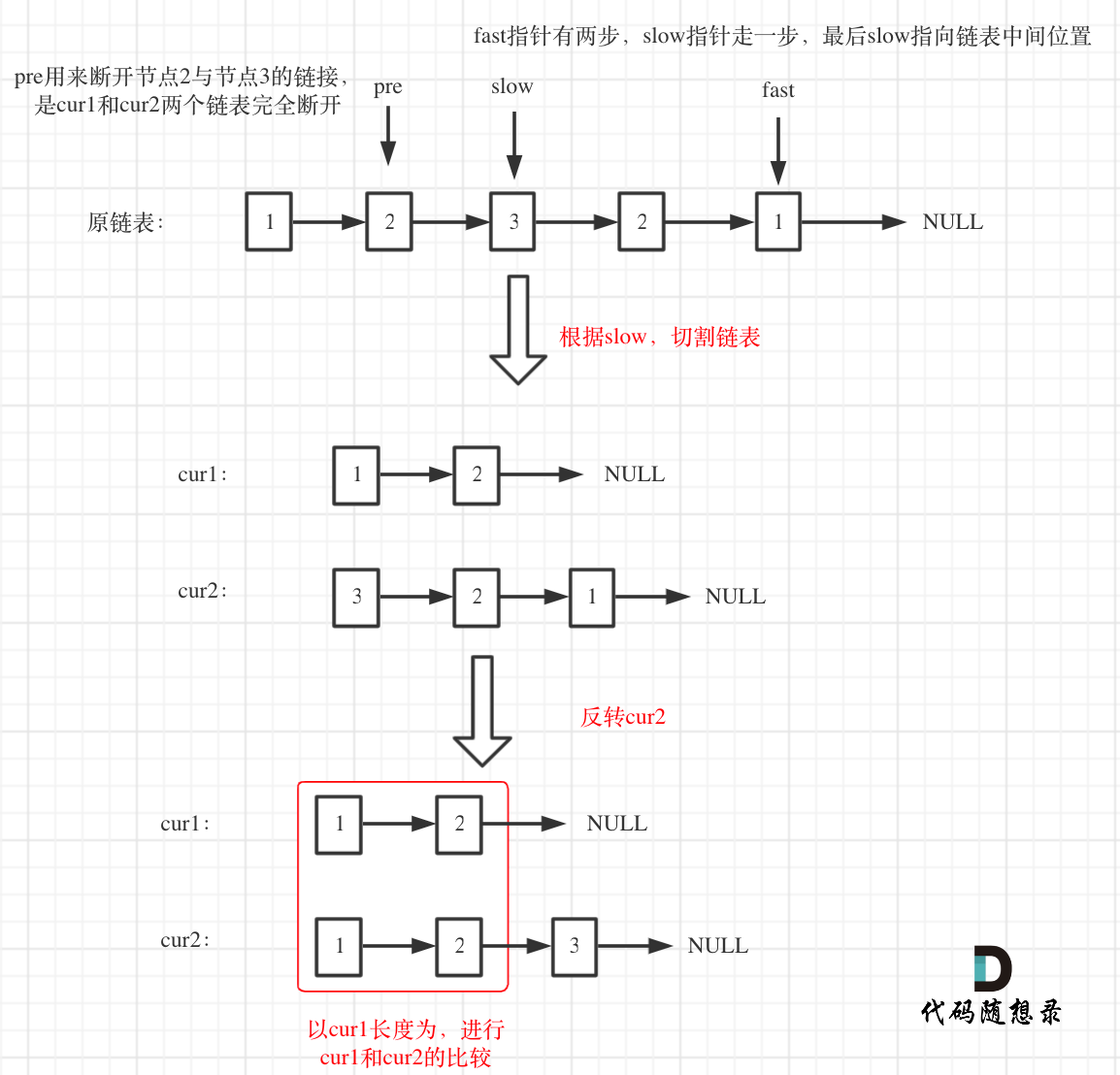
This involves the following steps:
- Use two pointers, one moving two steps at a time (fast) and one moving one step at a time (slow). When the fast pointer reaches the end, the slow pointer will be at the middle of the list.
- Use a pre pointer to record the node before the slow pointer to divide the list into two halves.
- The list is divided into two equal parts. If the list length is odd, the second half will have one more element.
- Reverse the second half of the list to get
cur2, while the first half iscur1. - Compare the nodes of
cur1andcur2sequentially forcur1's length.
As shown in the diagram:
Here is the code:
class Solution {
public:
    bool isPalindrome(ListNode* head) {
        if (head == nullptr || head->next == nullptr) return true;
        ListNode* slow = head; // Slow pointer to find the mid position
        ListNode* fast = head;
        ListNode* pre = head; // Record the previous node of the slow pointer to divide the list
        while (fast && fast->next) {
            pre = slow;
            slow = slow->next;
            fast = fast->next->next;
        }
        pre->next = nullptr; // Divide the list

        ListNode* cur1 = head;  // First half
        ListNode* cur2 = reverseList(slow); // Reverse the second half, if the list is odd, cur2 has one more node

        // Start comparing the two lists
        while (cur1) {
            if (cur1->val != cur2->val) return false;
            cur1 = cur1->next;
            cur2 = cur2->next;
        }
        return true;
    }
    // Reverse the list
    ListNode* reverseList(ListNode* head) {
        ListNode* temp; // Save the next node of cur
        ListNode* cur = head;
        ListNode* pre = nullptr;
        while(cur) {
            temp = cur->next;  // Save cur's next node, as we will change cur->next next
            cur->next = pre; // Reverse operation
            // Update pre and cur pointers
            pre = cur;
            cur = temp;
        }
        return pre;
    }
};
1
2
3
4
5
6
7
8
9
10
11
12
13
14
15
16
17
18
19
20
21
22
23
24
25
26
27
28
29
30
31
32
33
34
35
36
37
38
39
40
2
3
4
5
6
7
8
9
10
11
12
13
14
15
16
17
18
19
20
21
22
23
24
25
26
27
28
29
30
31
32
33
34
35
36
37
38
39
40
# Other Language Versions
# Java
// Method 1, Using an array
class Solution {
    public boolean isPalindrome(ListNode head) {
        int len = 0;
        // Calculate the length of the list
        ListNode cur = head;
        while (cur != null) {
            len++;
            cur = cur.next;
        }
        cur = head;
        int[] res = new int[len];
        // Add elements to the array
        for (int i = 0; i < res.length; i++){
            res[i] = cur.val;
            cur = cur.next;
        }
        // Check for palindrome
        for (int i = 0, j = len - 1; i < j; i++, j--){
            if (res[i] != res[j]){
                return false;
            }
        }
        return true;
    }
}

// Method 2, Using fast and slow pointers
class Solution {
    public boolean isPalindrome(ListNode head) {
        // If the list is empty or contains only one node, return true
        if (head == null && head.next == null) return true;
        ListNode slow = head;
        ListNode fast = head;
        ListNode pre = head;
        while (fast != null && fast.next != null){
            pre = slow;  // Record the previous node of slow
            slow = slow.next;
            fast = fast.next.next;
        }
        pre.next = null;  // Divide the two lists

        // First half
        ListNode cur1 = head;
        // Second half. Apply list reversal
        ListNode cur2 = reverseList(slow);

        while (cur1 != null){
            if (cur1.val != cur2.val) return false;

            // Move both nodes
            cur1 = cur1.next;
            cur2 = cur2.next;
        }
        return true;
    }
    ListNode reverseList(ListNode head){
        // Reverse the list
        ListNode tmp = null;
        ListNode pre = null;
        while (head != null){
            tmp = head.next;
            head.next = pre;
            pre = head;
            head = tmp;
        }
        return pre;
    }
}
1
2
3
4
5
6
7
8
9
10
11
12
13
14
15
16
17
18
19
20
21
22
23
24
25
26
27
28
29
30
31
32
33
34
35
36
37
38
39
40
41
42
43
44
45
46
47
48
49
50
51
52
53
54
55
56
57
58
59
60
61
62
63
64
65
66
67
68
69
2
3
4
5
6
7
8
9
10
11
12
13
14
15
16
17
18
19
20
21
22
23
24
25
26
27
28
29
30
31
32
33
34
35
36
37
38
39
40
41
42
43
44
45
46
47
48
49
50
51
52
53
54
55
56
57
58
59
60
61
62
63
64
65
66
67
68
69
# Python
# Array simulation
class Solution:
    def isPalindrome(self, head: Optional[ListNode]) -> bool:
        list=[]
        while head:
            list.append(head.val)
            head=head.next
        l,r=0, len(list)-1
        while l<=r:
            if list[l]!=list[r]:
                return False
            l+=1
            r-=1
        return True

# Reverse the second half
class Solution:
    def isPalindrome(self, head: Optional[ListNode]) -> bool:
        fast = slow = head

        # Find mid point including the middle element into the first half
        while fast and fast.next:
            fast = fast.next.next
            slow = slow.next
        node = None

        # Reverse the second half of the linked list
        while slow:
            slow.next, slow, node = node, slow.next, slow

        # Compare reversed and original half; maintain reversed list shorter than the first half
        while node:
            if node.val != head.val:
                return False
            node = node.next
            head = head.next
        return True
1
2
3
4
5
6
7
8
9
10
11
12
13
14
15
16
17
18
19
20
21
22
23
24
25
26
27
28
29
30
31
32
33
34
35
36
37
2
3
4
5
6
7
8
9
10
11
12
13
14
15
16
17
18
19
20
21
22
23
24
25
26
27
28
29
30
31
32
33
34
35
36
37
# Go
/**
 * Definition for singly-linked list.
 * type ListNode struct {
 *     Val int
 *     Next *ListNode
 * }
 */
// Method 1, using an array
func isPalindrome(head *ListNode) bool{
    // Calculate slice length to avoid frequent expansion
    cur, ln := head, 0
    for cur != nil {
        ln++
        cur = cur.Next
    }
    nums := make([]int, ln)
    index := 0
    for head != nil {
        nums[index] = head.Val
        index++
        head = head.Next
    }
    // Compare palindrome slice
    for i, j := 0, ln-1; i <= j; i, j = i+1, j-1 {
        if nums[i] != nums[j] { return false }
    }
    return true
}

// Method 2, fast and slow pointers
func isPalindrome(head *ListNode) bool {
    if head == nil && head.Next == nil { return true }
    slow := head
    fast := head
    pre := head
    for fast != nil && fast.Next != nil {
        pre = slow
        slow = slow.Next
        fast = fast.Next.Next
    }
    pre.Next = nil
    cur1 := head
    cur2 := ReverseList(slow)

    for cur1 != nil {
        if cur1.Val != cur2.Val { return false }
        cur1 = cur1.Next
        cur2 = cur2.Next
    }
    return true
}
func ReverseList(head *ListNode) *ListNode {
    var pre *ListNode
    cur := head
    for cur != nil {
        tmp := cur.Next
        cur.Next = pre
        pre = cur
        cur = tmp
    }
    return pre
}
1
2
3
4
5
6
7
8
9
10
11
12
13
14
15
16
17
18
19
20
21
22
23
24
25
26
27
28
29
30
31
32
33
34
35
36
37
38
39
40
41
42
43
44
45
46
47
48
49
50
51
52
53
54
55
56
57
58
59
60
61
62
2
3
4
5
6
7
8
9
10
11
12
13
14
15
16
17
18
19
20
21
22
23
24
25
26
27
28
29
30
31
32
33
34
35
36
37
38
39
40
41
42
43
44
45
46
47
48
49
50
51
52
53
54
55
56
57
58
59
60
61
62
# JavaScript
var isPalindrome = function(head) {
    const reverseList = head => {
        let temp = null;
        let pre = null;
        while(head != null){
            temp = head.next;
            head.next = pre;
            pre = head;
            head = temp;
        }
        return pre;
    }
    if(!head && !head.next) return true;
    let slow = head;
    let fast = head;
    let pre = head;
    while(fast != null && fast.next != null){
        pre = slow;
        slow = slow.next;
        fast = fast.next.next;
    }
    pre.next = null;
    let cur1 = head;
    let cur2 = reverseList(slow);
    while(cur1 != null){
        if(cur1.val != cur2.val) return false;
        cur1 = cur1.next;
        cur2 = cur2.next;
    }
    return true;
};
1
2
3
4
5
6
7
8
9
10
11
12
13
14
15
16
17
18
19
20
21
22
23
24
25
26
27
28
29
30
31
2
3
4
5
6
7
8
9
10
11
12
13
14
15
16
17
18
19
20
21
22
23
24
25
26
27
28
29
30
31
# TypeScript
Array simulation
function isPalindrome(head: ListNode | null): boolean {
    const helperArr: number[] = [];
    let curNode: ListNode | null = head;
    while (curNode !== null) {
        helperArr.push(curNode.val);
        curNode = curNode.next;
    }
    let left: number = 0,
        right: number = helperArr.length - 1;
    while (left < right) {
        if (helperArr[left++] !== helperArr[right--]) return false;
    }
    return true;
};
1
2
3
4
5
6
7
8
9
10
11
12
13
14
2
3
4
5
6
7
8
9
10
11
12
13
14
Reverse the second half of the list
function isPalindrome(head: ListNode | null): boolean {
    if (head === null || head.next === null) return true;
    let fastNode: ListNode | null = head,
        slowNode: ListNode = head,
        preNode: ListNode = head;
    while (fastNode !== null && fastNode.next !== null) {
        preNode = slowNode;
        slowNode = slowNode.next!;
        fastNode = fastNode.next.next;
    }
    preNode.next = null;
    let cur1: ListNode | null = head;
    let cur2: ListNode | null = reverseList(slowNode);
    while (cur1 !== null) {
        if (cur1.val !== cur2!.val) return false;
        cur1 = cur1.next;
        cur2 = cur2!.next;
    }
    return true;
};
function reverseList(head: ListNode | null): ListNode | null {
    let curNode: ListNode | null = head,
        preNode: ListNode | null = null;
    while (curNode !== null) {
        let tempNode: ListNode | null = curNode.next;
        curNode.next = preNode;
        preNode = curNode;
        curNode = tempNode;
    }
    return preNode;
}
1
2
3
4
5
6
7
8
9
10
11
12
13
14
15
16
17
18
19
20
21
22
23
24
25
26
27
28
29
30
31
2
3
4
5
6
7
8
9
10
11
12
13
14
15
16
17
18
19
20
21
22
23
24
25
26
27
28
29
30
31
Copyright © 2025 keetcoder