
# 200. Number of Islands
Problem Link (opens new window)
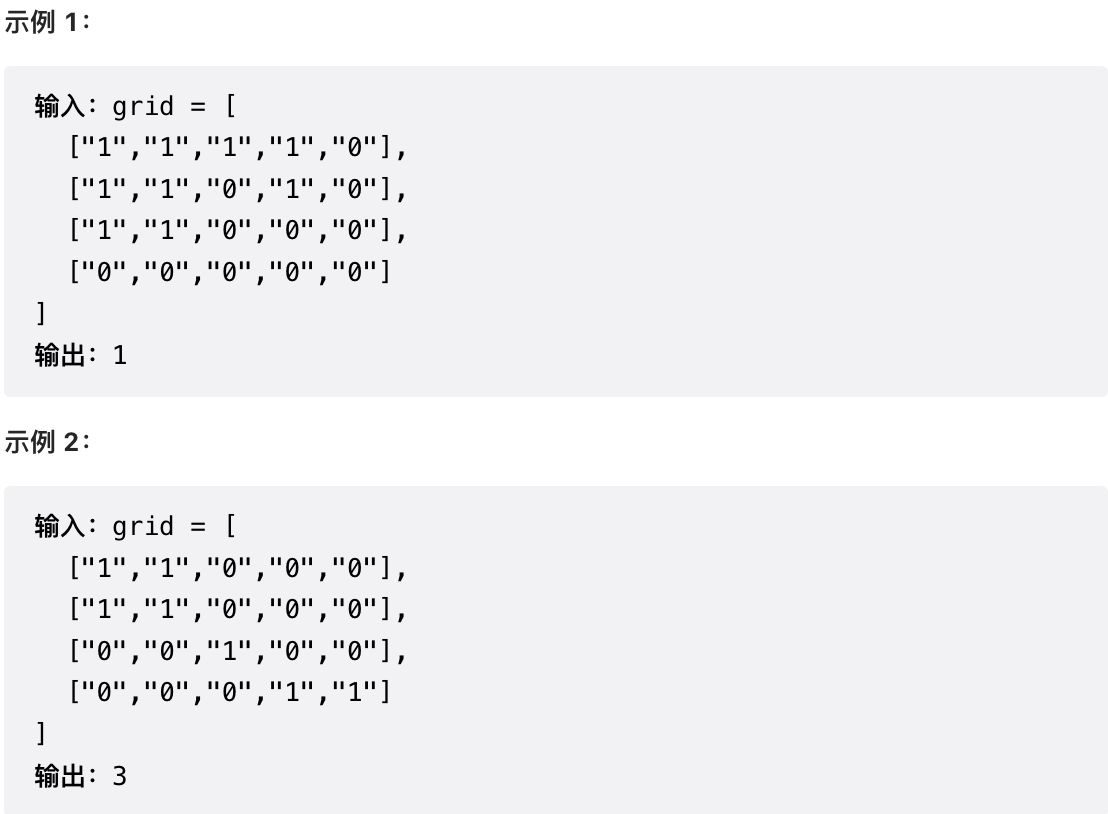
Given a 2D grid, consisting of '1' (land) and '0' (water), please calculate the number of islands in the grid.
An island is surrounded by water and is formed by connecting adjacent lands horizontally and/or vertically.
Additionally, you can assume that all four edges of the grid are surrounded by water.
Constraints:
- m == grid.length
- n == grid[i].length
- 1 <= m, n <= 300
- grid[i][j] is either '0' or '1'
# Approach
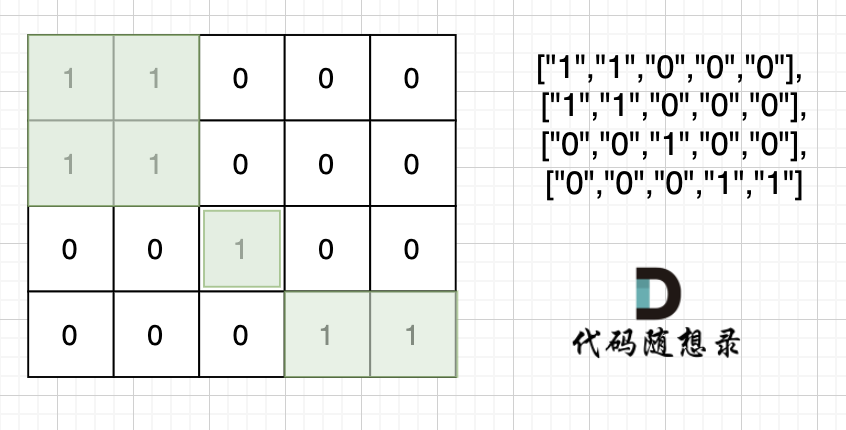
Pay attention to the condition stating that each island can only be formed by connecting adjacent lands horizontally and/or vertically.
This means diagonal connections are not counted. For example, in the second example, there are three islands, as shown:
This problem can be solved using DFS, BFS, or Union-Find as a foundational problem.
The solution approach involves encountering an unexplored land node and incrementing the counter. Then, mark all the lands reachable from this node.
Skip over marked land nodes and water nodes. This way, the counter will represent the final count of islands.
To mark all the lands from a given node, you can use DFS, BFS, or Union-Find.
# Depth-First Search
The following code uses DFS. If you are not familiar with DFS, it is suggested to first read this article: 797. All Paths From Source to Target (opens new window).
C++ code is as follows:
// Version 1
class Solution {
private:
    int dir[4][2] = {0, 1, 1, 0, -1, 0, 0, -1}; // Four directions
    void dfs(vector<vector<char>>& grid, vector<vector<bool>>& visited, int x, int y) {
        for (int i = 0; i < 4; i++) {
            int nextx = x + dir[i][0];
            int nexty = y + dir[i][1];
            if (nextx < 0 || nextx >= grid.size() || nexty < 0 || nexty >= grid[0].size()) continue;  // Out of bounds, skip
            if (!visited[nextx][nexty] && grid[nextx][nexty] == '1') { // Explore unvisited land

                visited[nextx][nexty] = true;
                dfs(grid, visited, nextx, nexty);
            }
        }
    }
public:
    int numIslands(vector<vector<char>>& grid) {
        int n = grid.size(), m = grid[0].size();
        vector<vector<bool>> visited = vector<vector<bool>>(n, vector<bool>(m, false));

        int result = 0;
        for (int i = 0; i < n; i++) {
            for (int j = 0; j < m; j++) {
                if (!visited[i][j] && grid[i][j] == '1') {
                    visited[i][j] = true;
                    result++; // Increment for an unvisited land
                    dfs(grid, visited, i, j); // Mark all connected lands as visited
                }
            }
        }
        return result;
    }
};
2
3
4
5
6
7
8
9
10
11
12
13
14
15
16
17
18
19
20
21
22
23
24
25
26
27
28
29
30
31
32
33
34
Many might wonder why there is no termination condition for the dfs function in the above code. It might seem risky without termination in recursion.
Actually, the termination condition is handled where dfs is called. If a direction is invalid, dfs isn't invoked.
You can also write it this way:
// Version 2
class Solution {
private:
    int dir[4][2] = {0, 1, 1, 0, -1, 0, 0, -1}; // Four directions
    void dfs(vector<vector<char>>& grid, vector<vector<bool>>& visited, int x, int y) {
        if (visited[x][y] || grid[x][y] == '0') return; // Termination: visited node or water
        visited[x][y] = true; // Mark as visited
        for (int i = 0; i < 4; i++) {
            int nextx = x + dir[i][0];
            int nexty = y + dir[i][1];
            if (nextx < 0 || nextx >= grid.size() || nexty < 0 || nexty >= grid[0].size()) continue;  // Out of bounds, skip
            dfs(grid, visited, nextx, nexty);
        }
    }
public:
    int numIslands(vector<vector<char>>& grid) {
        int n = grid.size(), m = grid[0].size();
        vector<vector<bool>> visited = vector<vector<bool>>(n, vector<bool>(m, false));

        int result = 0;
        for (int i = 0; i < n; i++) {
            for (int j = 0; j < m; j++) {
                if (!visited[i][j] && grid[i][j] == '1') {
                    result++; // Increment for an unvisited land
                    dfs(grid, visited, i, j); // Mark all connected lands as visited
                }
            }
        }
        return result;
    }
};
2
3
4
5
6
7
8
9
10
11
12
13
14
15
16
17
18
19
20
21
22
23
24
25
26
27
28
29
30
31
The difference between the two versions should be clear: In version 1, the call to dfs is only done for valid nodes, thus called only with valid nodes.
In version 2, it performs dfs regardless and checks for validity and returns if invalid during recursion.
Theoretically, version 1 is more efficient because it avoids unnecessary recursive calls by checking the conditions before calling dfs. But version 2 might be more intuitive. (There's not a huge difference, though)
Many people might notice that even with the same DFS problem, the implementations might differ, some with termination conditions, some without. This is the root cause—two different ways of writing it.
# Summary
Although this is a template problem for DFS and BFS, there are many intricate details that often get overlooked. I have highlighted all such important details that can be pitfalls later.
For now, I've provided the DFS implementation. If you find that I've explained it in detail, later I'll present the BFS solution as well. Despite being a template, there are still noteworthy points to discuss. Stay tuned!
# Other Language Versions
# Java
The following code uses Depth First Search (DFS). To count the number of islands without recording them multiple times, whenever an island is detected, we "sink" it — which means changing the island's cells from '1' to '0'. This ensures no repeated counting of islands. The DFS step effectively performs this "sinking". See code below:
public int numIslands(char[][] grid) {
    int res = 0; // Counter for the number of discovered islands
    for(int i = 0;i < grid.length;i++){
        for(int j = 0;j < grid[0].length;j++){
        	// Discover a "1", increment res, and sink the island
            if(grid[i][j] == '1'){
                res++;
                dfs(grid,i,j);
            }
        }
    }
    return res;
}
// Use DFS to "sink" an island
public void dfs(char[][] grid, int i, int j){
	// Search boundary: index out of bounds or reaching "0"
    if(i < 0 || i >= grid.length || j < 0 || j >= grid[0].length || grid[i][j] == '0') return;
    // Mark this land as "0"
    grid[i][j] = '0';
    // According to "Each island is formed by connecting adjacent lands horizontally or vertically", perform DFS on the adjacent vertices in the four directions
    dfs(grid,i - 1,j);
    dfs(grid,i + 1,j);
    dfs(grid,i,j + 1);
    dfs(grid,i,j - 1);
}
2
3
4
5
6
7
8
9
10
11
12
13
14
15
16
17
18
19
20
21
22
23
24
25
//Graph - DFS (consistent with Carl's code logic)
class Solution {
    boolean[][] visited;
    int dir[][] = {
        {0, 1}, //right
        {1, 0}, //down
        {-1, 0}, //up
        {0, -1} //left
    };
    public int numIslands(char[][] grid) {
        int count = 0;
        visited = new boolean[grid.length][grid[0].length];

        for(int i = 0; i < grid.length; i++){
            for(int j = 0; j < grid[0].length; j++){
                if(visited[i][j] == false && grid[i][j] == '1'){
                    count++;
                    dfs(grid, i, j);
                }
            }
        }
        return count;
    }

    private void dfs(char[][]grid, int x, int y){
        if(visited[x][y] == true || grid[x][y] == '0')
            return;

        visited[x][y] = true;

        for(int i = 0; i < 4; i++){
            int nextX = x + dir[i][0];
            int nextY = y + dir[i][1];
            if(nextX < 0 || nextY < 0 || nextX >= grid.length || nextY >= grid[0].length)
                continue;
            dfs(grid, nextX, nextY);
        }
    }
}
2
3
4
5
6
7
8
9
10
11
12
13
14
15
16
17
18
19
20
21
22
23
24
25
26
27
28
29
30
31
32
33
34
35
36
37
38
39
# Python:
# Version 1
class Solution:
    def numIslands(self, grid: List[List[str]]) -> int:
        m, n = len(grid), len(grid[0])
        visited = [[False] * n for _ in range(m)]
        dirs = [(-1, 0), (0, 1), (1, 0), (0, -1)]  # Four directions
        result = 0

        def dfs(x, y):
            for d in dirs:
                nextx = x + d[0]
                nexty = y + d[1]
                if nextx < 0 or nextx >= m or nexty < 0 or nexty >= n:  # Out of bounds, skip
                    continue
                if not visited[nextx][nexty] and grid[nextx][nexty] == '1':  # Unvisited land
                    visited[nextx][nexty] = True
                    dfs(nextx, nexty)

        for i in range(m):
            for j in range(n):
                if not visited[i][j] and grid[i][j] == '1':
                    visited[i][j] = True
                    result += 1  # Increment for an unvisited land
                    dfs(i, j)  # Mark all connected lands as visited

        return result
2
3
4
5
6
7
8
9
10
11
12
13
14
15
16
17
18
19
20
21
22
23
24
25
26
# Version 2
class Solution:
    def numIslands(self, grid: List[List[str]]) -> int:
        m, n = len(grid), len(grid[0])
        visited = [[False] * n for _ in range(m)]
        dirs = [(-1, 0), (0, 1), (1, 0), (0, -1)]  # Four directions
        result = 0

        def dfs(x, y):
            if visited[x][y] or grid[x][y] == '0':
                return  # Termination: visited node or water
            visited[x][y] = True
            for d in dirs:
                nextx = x + d[0]
                nexty = y + d[1]
                if nextx < 0 or nextx >= m or nexty < 0 or nexty >= n:  # Out of bounds, skip
                    continue
                dfs(nextx, nexty)

        for i in range(m):
            for j in range(n):
                if not visited[i][j] and grid[i][j] == '1':
                    result += 1  # Increment for an unvisited land
                    dfs(i, j)  # Mark all connected lands as visited

        return result
2
3
4
5
6
7
8
9
10
11
12
13
14
15
16
17
18
19
20
21
22
23
24
25
26
# We will use three states to mark each cell
# 0 indicates water
# 1 indicates land
# 2 indicates visited land
class Solution:
    def traversal(self, grid, i, j):
        m = len(grid)
        n = len(grid[0])

        if i < 0 or j < 0 or i >= m or j >= n:
            return   # Out of bounds
        elif grid[i][j] == "2" or grid[i][j] == "0":
            return

        grid[i][j] = "2"
        self.traversal(grid, i - 1, j) # Move up
        self.traversal(grid, i + 1, j) # Move down
        self.traversal(grid, i, j - 1) # Move left
        self.traversal(grid, i, j + 1) # Move right

    def numIslands(self, grid: List[List[str]]) -> int:
        res = 0


        for i in range(len(grid)):
            for j in range(len(grid[0])):
                if grid[i][j] == "1":
                    res += 1
                    self.traversal(grid, i, j)

        return res
2
3
4
5
6
7
8
9
10
11
12
13
14
15
16
17
18
19
20
21
22
23
24
25
26
27
28
29
30
31
# JavaScript
var numIslands = function (grid) {
    let dir = [[0, 1], [1, 0], [-1, 0], [0, -1]]; // Four directions

    let dfs = (grid, visited, x, y) => {
        for (let i = 0; i < 4; i++) {
            let nextX = x + dir[i][0]
            let nextY = y + dir[i][1]
            if (nextX < 0 || nextX >= grid.length || nextY < 0 || nextY >= grid[0].length)
                continue;
            if (!visited[nextX][nextY] && grid[nextX][nextY] === "1") {
                visited[nextX][nextY] = true
                dfs(grid,visited,nextX,nextY)
            }
        }
    }
    let visited = new Array(grid.length).fill().map(() => Array(grid[0].length).fill(false))

    let res = 0
    for (let i = 0; i < grid.length; i++) {
        for (let j = 0; j < grid[i].length; j++) {
            if (!visited[i][j] && grid[i][j] === "1") {
                ++res;
                visited[i][j] = true;
                dfs(grid, visited, i, j);
            }
        }
    }
    return res
};
2
3
4
5
6
7
8
9
10
11
12
13
14
15
16
17
18
19
20
21
22
23
24
25
26
27
28
29
# TypeScript
function numIslands(grid: string[][]): number {
	// Four directions
	const dir: number[][] = [[0, 1], [1, 0], [-1, 0], [0, -1]];
	const [m, n]: [number, number] = [grid.length, grid[0].length];

	function dfs(grid: string[][], visited: boolean[][], x: number, y: number) {
		for (let i = 0; i < 4; i++) {
			let nextX: number = x + dir[i][0];
			let nextY: number = y + dir[i][1];
			// Out of bounds, skip
			if (nextX < 0 || nextX >= m || nextY < 0 || nextY >= n) {
				continue;
			}
			// Unvisited and is land
			if (!visited[nextX][nextY] && grid[nextX][nextY] === '1') {
				visited[nextX][nextY] = true;
				dfs(grid, visited, nextX, nextY);
			}
		}
	}

	const visited: boolean[][] = Array.from({ length: m }, _ => new Array(n).fill(false));

	let result: number = 0;
	for (let i = 0; i < m; i++) {
		for (let k = 0; k < n; k++) {
			if (!visited[i][k] && grid[i][k] === '1') {
				++result; // Increment for an unvisited land
				visited[i][k] = true;
				dfs(grid, visited, i, k); // Mark all connected lands as visited
			}
		}
	}
	return result;
}
2
3
4
5
6
7
8
9
10
11
12
13
14
15
16
17
18
19
20
21
22
23
24
25
26
27
28
29
30
31
32
33
34
35
# Go
var DIRECTIONS = [4][2]int{{-1, 0}, {0, -1}, {1, 0}, {0, 1}}

func numIslands(grid [][]byte) int {
	res := 0

	visited := make([][]bool, len(grid))
	for i := 0; i < len(grid); i++ {
		visited[i] = make([]bool, len(grid[0]))
	}

	for i, rows := range grid {
		for j, v := range rows {
			if v == '1' && !visited[i][j] {
				res++
				dfs(grid, visited, i, j)
			}
		}
	}

	return res
}

func dfs(grid [][]byte, visited [][]bool, i, j int) {
        visited[x][y] = true
	for _, d := range DIRECTIONS {
		x, y := i+d[0], j+d[1]
		if x < 0 || x >= len(grid) || y < 0 || y >= len(grid[0]) {
			continue
		}
		if grid[x][y] == '1' && !visited[x][y] {
			dfs(grid, visited, x, y)
		}
	}

}
2
3
4
5
6
7
8
9
10
11
12
13
14
15
16
17
18
19
20
21
22
23
24
25
26
27
28
29
30
31
32
33
34
35
36
# Rust:
impl Solution {
    const DIRECTIONS: [(i32, i32); 4] = [(0, 1), (1, 0), (-1, 0), (0, -1)];
    pub fn num_islands(grid: Vec<Vec<char>>) -> i32 {
        let mut visited = vec![vec![false; grid[0].len()]; grid.len()];
        let mut res = 0;
        for (i, chars) in grid.iter().enumerate() {
            for (j, &c) in chars.iter().enumerate() {
                if !visited[i][j] && c == '1' {
                    res += 1;
                    Self::dfs(&grid, &mut visited, (i as i32, j as i32));
                }
            }
        }
        res
    }

    pub fn dfs(grid: &Vec<Vec<char>>, visited: &mut Vec<Vec<bool>>, (x, y): (i32, i32)) {
        for (dx, dy) in Self::DIRECTIONS {
            let (nx, ny) = (x + dx, y + dy);
            if nx < 0 || nx >= grid.len() as i32 || ny < 0 || ny >= grid[0].len() as i32 {
                continue;
            }
            let (nx, ny) = (nx as usize, ny as usize);
            if grid[nx][ny] == '1' && !visited[nx][ny] {
                visited[nx][ny] = true;
                Self::dfs(grid, visited, (nx as i32, ny as i32));
            }
        }
    }
}
2
3
4
5
6
7
8
9
10
11
12
13
14
15
16
17
18
19
20
21
22
23
24
25
26
27
28
29
30